Leon County Government has a proud history of meeting our community’s greatest needs, being a responsible fiscal steward of taxpayer dollars, and working every day to make our community a special place to live, work and play, all of which depend on a stable, locally controlled source of funding.
On June 2, 2026, the Florida Legislature passed a proposed constitutional amendment to significantly increase Florida’s homestead exemption, along with related changes to property tax administration. The amendment appears on the Nov. 3, 2026 general election ballot as Amendment 3 and requires approval by 60% of voters to take effect, beginning in 2027.
Below, you will find common questions about the amendment to help you learn more about its local impact.
Shareable Resources
-
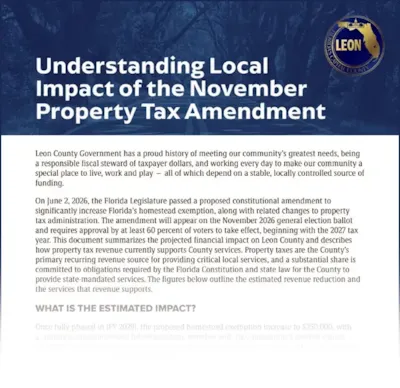
Understanding the Local Impact of the November Property Tax Amendment
A County-prepared overview of the projected financial impact on Leon County, including the estimated revenue reduction, the obligations the County must fund first, and the services supported by the revenue that remains.
-
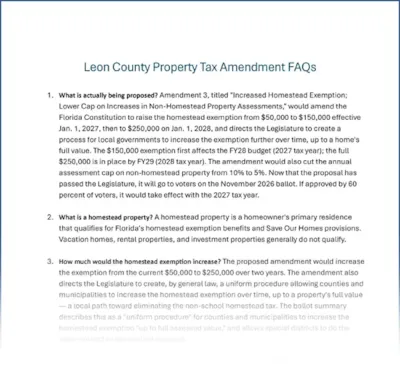
Leon County Property Tax Amendment FAQs (also below)
A plain-language question-and-answer document addressing the most common questions about the amendment and its local impact, including what the measure does, how much revenue Leon County would lose, what services are funded first, what would remain for everything else, the effect on the EMS MSTU, and what happens next on the November ballot.
-
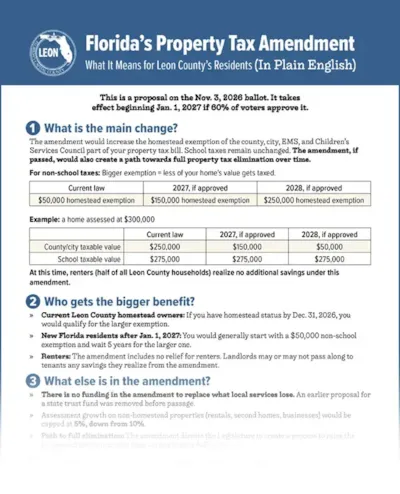
Property Tax Amendment "At-a-Glance" infographic
A one-page visual that distills the key facts and the local impact into a quick, shareable snapshot.
-
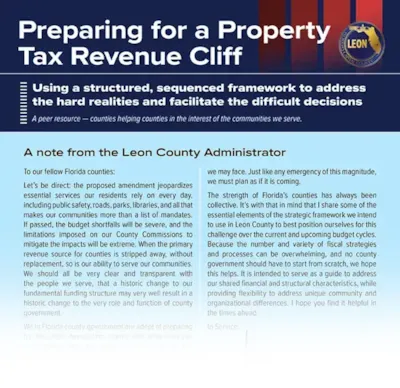
Preparing for a Property Tax Revenue Cliff (for fellow Florida counties)
A peer resource helping fellow Florida counties in the interest of the communities we serve.
-

Outline of Leon County Cost Savings and Avoidances
A one-page visual that summarizes the cost savings or avoidances from employee-driven innovations.
Frequently Asked Questions
1. What is actually being proposed?
Amendment 3, titled "Increased Homestead Exemption; Lower Cap on Increases in Non-Homestead Property Assessments," would amend the Florida Constitution to raise the homestead exemption from $50,000 to $150,000 effective Jan. 1, 2027, then to $250,000 on Jan. 1, 2028, and directs the Legislature to create a process for local governments to increase the exemption further over time, up to a home's full value. The $150,000 exemption first affects the FY28 budget (2027 tax year); the full $250,000 is in place by FY29 (2028 tax year). The amendment would also cut the annual assessment cap on non-homestead property from 10% to 5%. Now that the proposal has passed the Legislature, it will go to voters on the November 2026 ballot. If approved by 60% of voters, it would take effect with the 2027 tax year.
2. What is a homestead property?
A homestead property is a homeowner's primary residence that qualifies for Florida's homestead exemption benefits and Save Our Homes provisions. Vacation homes, rental properties, and investment properties generally do not qualify.
3. How much would the homestead exemption increase?
The proposed amendment would increase the exemption from the current $50,000 to $250,000 over two years. The amendment also directs the Legislature to create, by general law, a uniform procedure allowing counties and municipalities to increase the homestead exemption over time, up to a property's full value — a local path toward eliminating the non-school homestead tax. The ballot summary describes this as a "uniform procedure" for counties and municipalities to increase the homestead exemption "up to full assessed value," and allows special districts to do the same subject to referendum approval.
4. Do the exemption amounts stay fixed over time?
No. Beginning in 2028 for the new-resident exemption and in 2029 for the $250,000 exemption, the exempt amounts adjust upward each year for inflation when the Consumer Price Index rises (they do not decrease in a year prices fall). Because the exempt amount grows automatically, the share of a home's value that is taxed continues to shrink over time, separate from the initial two-year phase-in.
5. How much would this cost Leon County?
Once fully phased in by FY 2029, the $250,000 homestead exemption and the companion 5% non-homestead cap are together estimated to reduce Leon County property tax revenue by approximately $70.7 million per year, based on the Leon County Property Appraiser's parcel-level analysis.
6. If the amendment passes, what would it mean for Leon County services?
Once fully phased in over two years (FY 2029), Leon County would lose about $70.7 million a year in property tax revenue. To put that in perspective: of the roughly $165 million we would still collect, about $161 million is already committed to state mandates and constitutional officers. That leaves only about $3.5 million to fund everything else the County provides, including public safety, disaster response, emergency medical services, parks, solid waste, transportation, stormwater maintenance, building and permitting, animal control, veterans services, and more.
7. How would this affect my County services?
Your property tax bill may be lower, but so would the resources for the services those taxes support. A reduced tax bill does not reduce the need for a deputy to answer an emergency call, an ambulance to respond, or a library to stay open. Before voting, residents should consider the savings against the effect on the local services they rely on.
8. Won't the state provide support to local governments to offset these impacts?
The amendment includes no new, dedicated state funding to replace what local governments would lose. Florida law continues limited offsets for "fiscally constrained" counties — generally small, rural counties — but Leon County does not qualify and would not receive them. Any broader support would be subject to future state Legislatures, with no guarantee that Leon County would receive funding.
9. Hasn't Leon County been very fiscally responsible? Can you find more efficiencies?
Leon County has deliberately exercised fiscal stewardship, holding the countywide millage rate flat for 15 years, charging no impact fees, and relying minimally on fee revenue, while maintaining one of the lowest per-capita budgets of any county in Florida. There is no easy budgetary method to mitigate a reduction in property tax revenue this large. As the state capital, home to FSU, FAMU, Tallahassee State College and major state facilities, all tax-exempt, Leon also provides services to substantial property that does not contribute to the tax roll, which a one-size-fits-all formula does not account for.
10. Why wouldn’t there be universal support for savings for taxpayers?
Independent analysts — including Florida TaxWatch and the nonpartisan Florida Policy Project — have described the measure as a "tax shift" rather than a simple tax cut. Their point is that reducing property tax revenue does not reduce the cost of services, so the difference can reappear as higher fees, new charges, or reduced services that reach renters and businesses as well as homeowners.
11. When would this take effect?
Initial exemptions would start with the 2027 tax year, so the FY28 budget would be impacted by the loss of tax revenue. Deliberate budgeting conversations regarding the elimination of services and/or reductions in service levels would start well beforehand.
12. Would second homes and investment properties qualify for the additional homestead
exemption?
No. The proposal primarily targets homesteaded primary residences. However, it includes provisions to reduce annual assessment growth caps on non-homestead properties from 10% to 5%, potentially slowing future tax increases on those properties.
13. How does the five-year waiting period for new residents work?
A person who is not a Florida resident on December 31, 2026, would receive the existing $50,000 non-school homestead exemption upon qualifying for a homestead exemption, with the increased exemption beginning with the fifth year of exemption, to the extent permitted by the U.S. Constitution. The five-year period runs from the year the exemption is first claimed rather than from the date residency is established. Current Florida homestead owners are not subject to this waiting period.
14. Why is this proposal important to Leon County Government?
Property taxes are one of the primary revenue sources supporting county operations, including public safety, emergency management, infrastructure, parks, libraries, environmental programs, and constitutional offices. Significant reductions in property tax collections could require changes to county budgets, service levels, fees, or alternative revenue sources.
15. Does the amendment limit what the County can spend property taxes on?
In part. The amendment writes into the state constitution a list of allowable uses for county and city property taxes: public safety; education and public schools; infrastructure; natural resources; bond debt service; retirement benefits for employees; and operations and administration. The summary further provides that other expenditures may be approved by county officers or county or municipal governing bodies unless prohibited by general law. In ordering the ballot summary rewritten, the court noted that the amendment would place in the Constitution, for the first time, the Legislature's ability to control how counties and cities spend property tax revenue. Because the allowable-use categories are broad, the practical limit on most local services is not this list — it is the amount of revenue that remains after the reduction.
16. Would the proposal eliminate all property taxes in Leon County?
No — not all of them. School taxes, and taxes on other property such as rentals, second homes and commercial property, would continue. The amendment does, however, set a path toward eliminating the homestead (non-school) portion over time, by directing the Legislature to prescribe a uniform procedure that would allow counties and municipalities — and special districts, subject to referendum approval — to raise the homestead exemption up to a property's full assessed value. And the impact is significant well before any full phase-out: at the $250,000 exemption, it would reduce County revenue by about $70.7 million a year, leaving only about $3.5 million once state mandates and constitutional officers are funded, and affecting all other County services.
17. Would the Leon County EMS Municipal Service Taxing Unit (MSTU) be impacted?
Yes. The proposal would significantly reduce funding for services funded by the MSTU. Property taxes are what fund the EMS MSTU. Because the EMS MSTU relies on property tax revenue, services may be required to merge or face reductions in service levels. This could mean fewer ambulances and slower response times.
18. How would local governments like Leon County make up the difference from lost property tax revenue?
The state has not identified a dependable, recurring replacement source. Lack of funding would also prompt local governments to consider cuts to essential services or raising other fees and taxes.
19. Could the County simply raise its millage rate to make up the difference?
It is harder than it sounds. A companion law (SB 4-F) tightened the votes required to raise the rate. A simple majority of the Board can set the rate only up to the "rolled-back rate" — roughly the rate that collects the same revenue as the prior year. A two-thirds vote of the Board is required to go above that, and a unanimous vote of the Board, or approval by voters in a referendum, is required to exceed 110% of the rolled-back rate. Replacing a large revenue loss through the millage rate alone would require extraordinary Board agreement or a public vote.
20. Could residents see new fees even if property taxes decrease?
Yes. If local governments lose property tax revenue, they may evaluate alternative sources or increases in funding mechanisms that could include solid waste fees, stormwater fees, fire service assessments, impact fees, or permit and licensing fees, among others. Residents may experience increases in fees and reductions in services.
21. What are other ways Leon County may respond if revenues decline?
This will require a combination of significant service level reductions and/or tax and fee increases. Potential responses could include service level reductions, hiring freezes, delayed capital projects, increased user fees, special assessments, seeking additional state funding, operational efficiencies and cost reductions.
22. Can this policy be reversed if it doesn’t work out?
This policy decision by the Florida Legislature, if approved by voters, can't be easily reversed. Reestablishing this critical revenue source would require another constitutional amendment, which would be subject to statewide voter approval.
23. What happens next?
The proposal will now be placed on the statewide ballot in November 2026 and must receive 60% voter approval to take effect. If approved, implementation would occur over multiple years. The ballot title and summary were rewritten in August 2026. On Aug. 4, a Leon County circuit court ordered the Attorney General to revise them; revised language was filed Aug. 13 and is on file with the Florida Department of State. The amendment itself was not changed by that ruling, and it remains on the Nov. 3, 2026, ballot as Amendment 3.
24. If the amendment passes, would I still pay property taxes as a homeowner?
Yes. The exemption applies only to non-school property taxes, and for most homeowners the school portion is usually the largest part of the bill. The amendment raises the homestead exemption; it does not, by itself, end a homeowner's tax bill.
25. Does this change my school taxes?
No. The amendment applies only to non-school levies. School district property taxes are not affected, which is part of why a homeowner's bill would not disappear.
26. What would this mean for renters?
Renters would not receive a direct reduction, because the homestead exemption applies to owner-occupied primary residences. Renters could still be affected indirectly, through any new fees local governments adopt to replace lost revenue, through reduced services, and potentially through changes to rents as property costs shift. The amendment also authorizes — but does not require — the Legislature to provide renters relief from property taxes through a future general law; any such relief would be in whatever form and amount a future Legislature decides, and none is defined or funded in the amendment itself. About half of Leon County households, and a majority within the City of Tallahassee, are renters.
27. Where does the $70.7 million estimate come from?
From the Leon County Property Appraiser, who analyzed the County's actual tax roll parcel by parcel. It reflects Leon County's specific property data rather than a statewide formula, which makes it the most precise figure available for local planning.
28. Is the County telling me to vote no on the property tax amendment?
No. The Leon County Government's role is to provide neutral, factual information so residents can make an informed decision, and state law restricts local governments from using public resources to advocate for or against a ballot measure. Individual elected officials may share their own opinions.
29. Could this affect the County's credit rating or its ability to recover from a hurricane?
Potentially. Leon County maintains low debt and a strong credit rating, which let it borrow affordably for major projects and disaster recovery. A large, permanent loss of its primary revenue source could pressure that standing over time and raise future borrowing costs, including the borrowing the County would rely on to rebuild after a storm.
30. Isn't the County just trying to protect its own budget?
It's a fair question. The honest answer is that nearly 70 cents of every County property-tax dollar is already committed by law, to the Sheriff, the constitutional officers, the courts and Medicaid, before any discretionary service. The County has also held its millage flat for 15 years and charges no impact fees. The concern isn't the budget in the abstract; it's whether we can keep delivering the services and quality of life residents count on every day.